
Analyse a striker through availability, shot access, chance quality, finishing, link play and defensive work instead of using goals as the whole role.
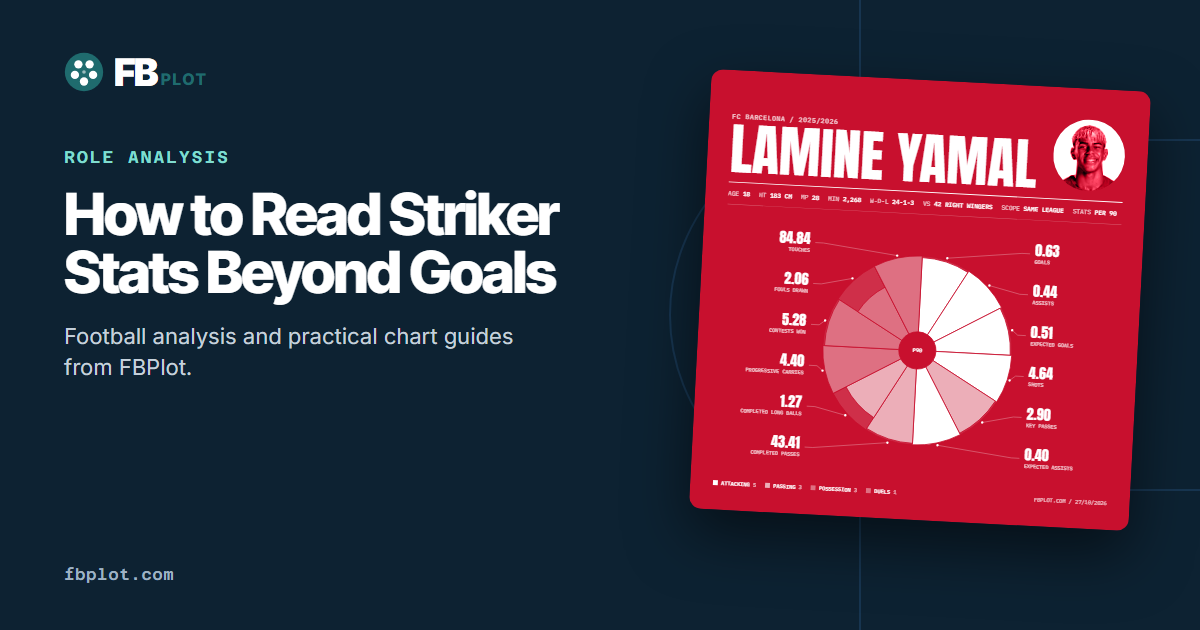
A role-led framework for reading football striker statistics, from receiving and shooting to creation, duels and the team context behind the numbers.
The first question about a striker is usually “How many goals?” It is a fair question. Goals decide matches and cannot be edited out of the role. The mistake is allowing the answer to end the analysis.
A striker profile should explain how the player reaches chances, what happens to the shots, what they offer when the finish is unavailable and how the team's attack shapes every number.
Begin With the Striker's Contract
“Striker” can mean a penalty-box finisher, a runner behind, a target forward, a false nine or a forward who leads the press. Write the job before choosing the metrics.
For example:
Stay high between the centre-backs, attack the six-yard box, threaten space behind and provide a direct outlet when the team cannot play through midfield.
That sentence makes aerial duels and off-ball running relevant. A false-nine contract would shift attention toward touches, passing and creation. The data set should follow the football role, not a generic forward template.
Availability Comes Before Rate
Minutes, starts and competition scope establish whether the sample represents a regular role or a handful of appearances. Per-90 numbers help compare frequency while on the pitch, but they can flatter substitutes who enter against tired defences or hide the value of staying available.
Keep total minutes beside every rate. If two strikers have very different workloads, use the method in comparing players with unequal minutes.
Shot Access Is a Team and Player Outcome
Shots and xG describe how often the striker reaches attempts and the broad quality of those chances under the chosen model. High xG can reflect intelligent movement, strong service, penalty responsibility or all three.
Ask where the chances originate and what the role asks the player to attack. A striker who pins defenders to open space for others can contribute without receiving the final pass. Aggregate event data may not capture that work.
The comparison should include team chance creation. A forward cannot shoot a pass that never arrives.
Separate Selection, Execution and Result
The shooting sequence needs three layers:
- selection: shots and xG;
- execution: on-target, off-target, blocked outcomes and xGOT where available;
- result: goals and G-xG.
The shots-off-target guide explains why a miss count is not a finishing grade. The xGOT versus xG guide separates pre-shot chance quality from on-target execution, while Goals minus xG keeps realised outcomes in their proper sample.
Read a Real Forward Profile Clockwise
This FBPlot pizza uses a forward-oriented selection for Erling Haaland. It illustrates the sequence rather than proving a current conclusion about the player.
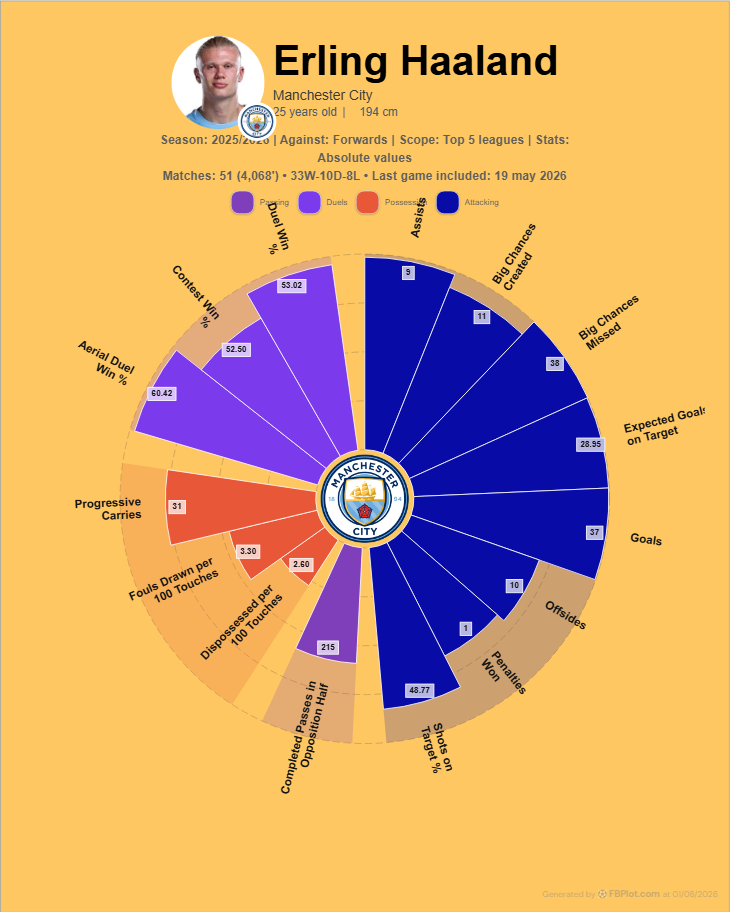
Read from workload to outcome. If goals stand out, inspect xG and shots. If aerial duels stand out, inspect attempts, location and the team's direct-play volume. The filled area is not an overall striker rating.
Link Play Has More Than One Shape
Touches, attempted passes, key passes and assists can describe involvement away from the final shot, but target play is not always captured by completion percentage. A difficult layoff under contact and a safe return pass can enter the same completed-pass count.
For a dropping forward, receiving zones and who runs beyond them matter. For a target striker, aerial contests, fouls drawn and second-ball outcomes matter. Use video to connect the event to the attacking structure.
Duels Need the Team's Intention
A large aerial-duel total can be evidence of a useful outlet. It can also show that the team repeatedly played hopeful direct balls. Win percentage, volume and consequence all matter.
Ground contests can reflect dribbling, ball protection or loose-ball work. Do not combine every duel into a bravery score. The duels-won guide provides the fuller audit.
Defensive Work Starts With the Pressing Trigger
Tackles and recoveries are weak proxies for pressing if the player's job is to curve a run and block the pass into midfield. A well-executed press can force a long ball without the striker touching it.
Use defensive events when they match the instruction. Then confirm with team shape, pressure data if available and video. “Low tackles” is not the same as “does not press.”
Build the Final Paragraph in Layers
A useful striker report can be concise without being shallow:
The forward reached a strong volume of chances and accumulated substantial xG across the selected competitions. Goals ran above the model's expectation, while on-target evidence should be reviewed over a longer sample. His profile also shows regular direct involvement, although the consequence of aerial contests and his pressing assignment require video.
Every clause points to visible evidence or an explicit next step.
Open the FBPlot Profile editor, choose a forward comparison group and start with six to eight metrics that match the written contract. Add a metric only when you can explain which striker task it tests.
Found this helpful? Share it with your network
More Articles
How to Read Attacking Midfielder Stats Without Counting Only Output
Read attacking-midfielder statistics through reception, progression, creation, box threat and defensive responsibility—not goals and assists alone.
How to Read Full-Back Stats: Defending, Progression and Width
Full-back statistics only make sense after identifying the role: overlapping, inverted, defensive, creative or transition-focused.