
Touches describe involvement, not influence. Interpret them through role, location, team possession, carries, passing and what the player does next.
Learn what touches can and cannot tell you about a football player, with a practical framework for opportunity, retention, progression and team share.
A midfielder can touch the ball 100 times and leave the match without one memorable action. A forward can touch it 25 times and decide the game. The obvious lesson is not that touches are useless. It is that involvement and influence are different ideas.
Touches become valuable when you use them as the entrance to a possession story: how often was the player involved, where did that involvement occur, and what actions followed?
What Are Touches in Football Statistics?
A touch is a recorded contact with the ball under the provider's event model. The exact collection rules belong to the dataset, so counts should not be assumed identical across services. In FBPlot, Touches is a possession metric and also supports related opportunity ratios such as Carries per 100 Touches, Miscontrols per 100 Touches and Fouls Drawn per 100 Touches.
That design reveals the most useful analytical role for touches: they can provide a denominator for what a player does when possession reaches them.
Volume Describes Access to the Ball
High touch volume can mean the player is central to buildup. It can also mean the team dominates possession, restarts frequently through the same defender or circulates slowly in front of a deep block. Low volume can reflect isolation, a transition role, a deliberate decoy or simply fewer team possessions.
Before interpreting the player's count, ask:
- how much of the ball did the team have?
- where in the structure did the player receive it?
- was the match played against a high press or a low block?
- did set pieces or a scoreline change the pattern?
Touches are often evidence of opportunity supplied by the team. They are not automatically evidence of initiative by the player.
Location Is More Informative Than a Grand Total
A centre-back accumulating touches around the halfway line and a number ten receiving between the lines are not performing the same work. If location-specific touch data is available, split the pitch into zones that match the role: own third, middle third, attacking third and penalty area.
When only the total is available, resist pretending it contains the map. Use passing, carries and role context to infer hypotheses, then verify them with positional data or video.
The question should evolve from “How many touches?” to “What kind of possession access did these touches represent?”
What Happened After the Touch?
Touches become analytical when connected to decisions. A player can pass, carry, shoot, lose control, draw a foul or hold the ball long enough to reshape the next action.
For a progressive ball carrier, compare touches with carries and progressive carries. For a distributor, compare them with attempted passes, completion and progressive direction. For a forward, connect them to shots, key passes and penalty-area involvement.
Per-100-touch ratios are useful here because they ask what share of possession opportunities produced a given event. They do not replace per 90. A player can progress frequently per touch while receiving the ball rarely; another can produce more progressions per 90 through sheer involvement.
A Winger Profile Shows Why Opportunity Matters
The FBPlot pizza below combines possession and attacking rows for a wide player. The chart should be read as a sequence—access, action, outcome—not as one score.
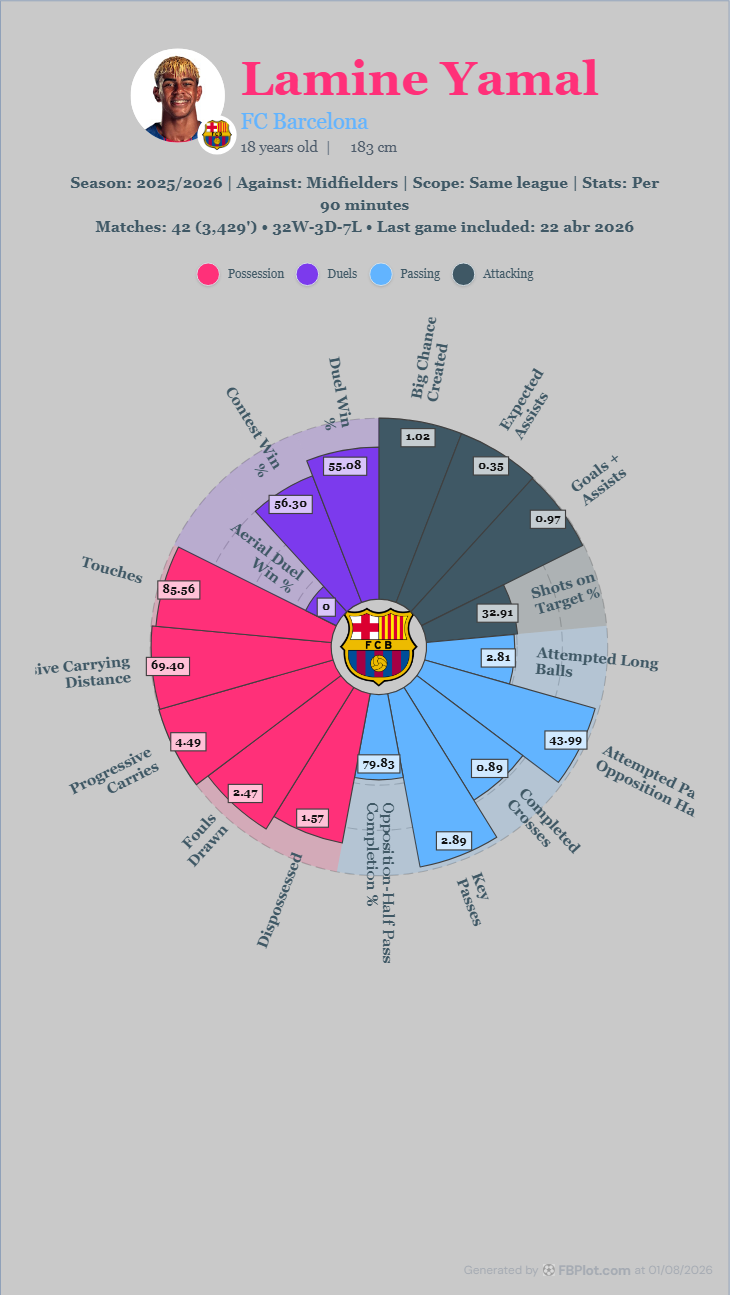
A high carry or chance-creation row means something different when the player also receives a large share of team possession. For a fuller wide-player method, see how to read winger statistics.
Per 90 and Team Contribution Tell Different Stories
Touches per 90 estimate involvement while the player is on the pitch. Team contribution, for supported metrics, asks how much of the team's activity belongs to that player. Those answers can diverge because teams play at different tempos and distribute possession differently.
Imagine two midfielders with similar touches per 90. One belongs to a team with enormous possession volume; the other handles a much larger share of a lower-volume team's ball. The first looks similar by rate, while the second may be more structurally central.
The dedicated team-contribution guide explains when that second lens helps and when it can exaggerate a player's share of an unhealthy team pattern.
Touches Do Not Measure Courage or Creativity
Analysts sometimes infer personality from a count: many touches become “always showing,” few touches become “hiding.” Those claims need movement and passing-option evidence. A player can offer constantly and still be bypassed; another can be instructed to pin the back line away from the ball.
Likewise, touches do not identify risk. A safe pass under no pressure and a reception between three opponents both add involvement. Pair the count with location, action type and match review before describing responsibility.
Write the Finding as a Chain
A useful paragraph connects opportunity to action:
The player received substantial possession in this sample and converted a meaningful share of those touches into carries and progressive actions. The pattern suggests a central ball-progression role, although touch location and the team's possession structure need video confirmation.
The chain makes each inference visible. If the evidence breaks at one link, the conclusion can be revised without discarding the whole profile.
Open the Touches metric page, then use the Player Bar Chart to place Touches beside Carries, Progressive Carries, Attempted Passes, Miscontrols and Fouls Drawn. The aim is not to reward contact with the ball; it is to understand what the player did with access to it.
Found this helpful? Share it with your network
More Articles
Aerial Duel Win Percentage in Football: Context Before Ranking
Aerial duel win percentage needs attempts, role, location, opponents and sample size before it can support a player-comparison claim.
Beyond Goals and Assists: Building a Better Player Analysis
Goals plus assists is a useful first line, but it cannot explain role, chance quality, possession work or the sample behind a player's output.