
Read winger statistics through receiving, progression, creation, shooting and defensive work instead of starting and ending with goal contributions.
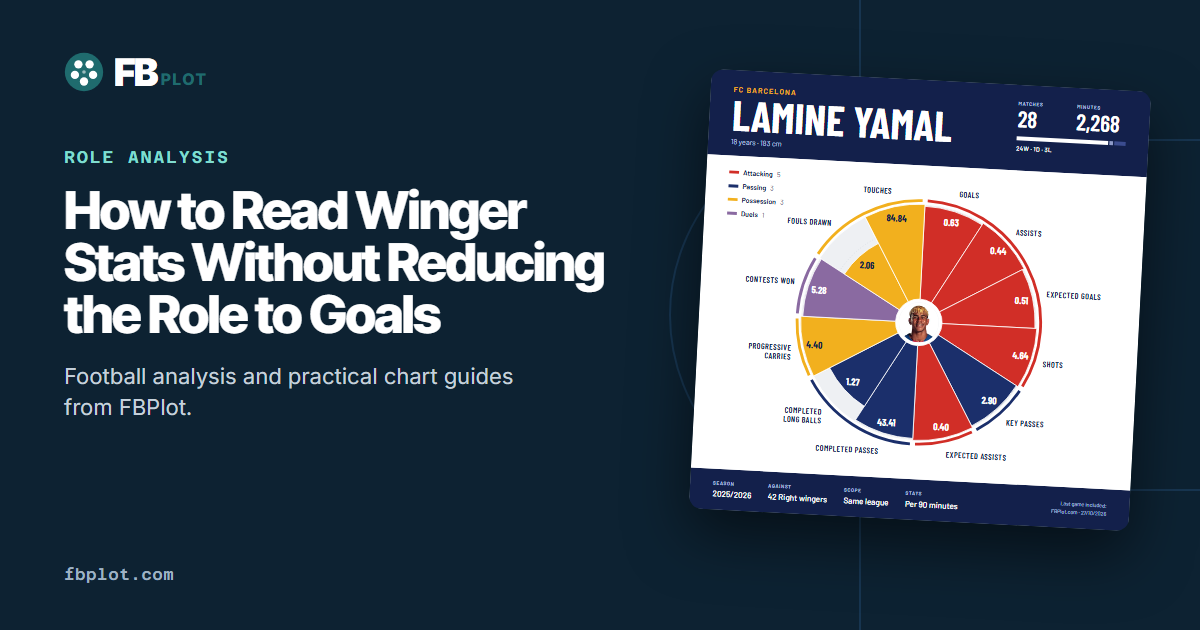
A role-led method for analysing football wingers. Build the metric set from the player's job, keep opportunity and minutes visible, and use the chart to direct—not replace—match review.
The word “winger” can describe a touchline dribbler, an inside forward, a wide playmaker or a midfielder who drops into a back five without the ball. A single position label does not tell you which version is on the pitch.
That is why winger analysis should begin with a role sentence rather than a metric list.
This player receives wide on the right, attacks the full-back, moves inside near the box and is expected to create as well as finish.
Change that sentence and the relevant statistics change with it. The goal is not to find the definitive winger template. It is to build a profile that matches the football job you are actually evaluating.
The Five-Phase Winger Profile
A useful winger analysis follows the possession from arrival to outcome:
- Receiving: where and how often does the player become available?
- Progression: does the player advance through carries, passes or combinations?
- Creation: what kind of chances follow?
- Finishing: how often and from what opportunity does the player shoot?
- Out of possession: what is required when the team loses the ball?
This sequence creates a story. A random set of ten attacking metrics creates a shape.
Receiving: Opportunity Before Output
Touches provide a rough sense of involvement but need location and team context. A winger in a possession-heavy side may receive constantly against a settled block. A transition winger may receive less often but with open grass ahead.
If available, use touches in advanced areas, receptions, attempted passes or carrying opportunity to understand the input. Without an opportunity measure, low output can be mistaken for poor execution when the player was rarely found.
Team contribution can help here. It asks what share of supported team activity came through the player, which is different from event frequency per 90.
Progression: Not Every Winger Advances the Same Way
Progressive carries, carrying distance, take-ons and fouls drawn can describe a ball carrier. Key passes, crosses and forward passes can describe a player who releases the ball earlier. Neither route is automatically superior.
Compare the method with the role. A winger instructed to hold width may attempt more isolated take-ons. An inside forward may combine through short passes and reserve carries for the final third. The companion guide to progressive carries by role shows how the same metric changes meaning across positions.
Creation: Separate Frequency From Chance Value
Assists are the realised outcome. Key passes describe recorded shot creation. Expected assists adds an estimate of the chances' value.
Read the three layers separately. A winger can create many low-value shots, a few high-value chances, or valuable chances that teammates do not convert. The key passes versus expected assists guide explains those disagreements in detail.
Also ask how the chances are created. A cross from deep, a cut-back after a dribble and a slipped pass from the half-space may share an xA column while representing different tactical strengths.
Finishing: Outcome Needs a Shot Profile
Goals and G+A matter, but they need shots, shots on target, expected goals and minutes around them. A winger taking a high share of difficult shots should not be evaluated as if every attempt came from a striker's central zone.
Use Shots on Target % for the share of attempts reaching the target, not as a complete finishing grade. Keep shot volume and chance quality visible.
A Real Winger Chart
This FBPlot pizza uses a winger-oriented metric set for Bukayo Saka. It keeps possession, passing, duel and attacking rows in one view rather than presenting goals as the whole role.

Read the labels clockwise, one question at a time. Do not treat the filled area as an overall rating. If two related axes reward the same action, remove one before comparing players.
Defensive Work: Start With the Instruction
Pressure events, recoveries, tackles and duels can add useful context, but wide players defend in different structures. One presses the centre-back, another protects the full-back, and another stays high for transition.
A low tackle rate may reflect a passive role, territorial dominance or ineffective defending. A high rate may reflect aggressive work or a team repeatedly losing possession on that side. Video and team shape decide which explanation survives.
Use defensive metrics to test a stated responsibility, not to add moral credit for “work rate”.
Compare Wingers With a Written Contract
Before placing two profiles together, write down:
- the side and role each player usually occupies;
- period, competitions and minutes;
- total, per-90, percentage or contribution mode;
- the comparison population and eligibility rule;
- set-piece responsibility;
- any role change during the sample.
This contract prevents a right-sided creator and a left-sided inside forward from being judged as if their opportunities were identical. If the roles are intentionally different, the comparison should describe the trade-off.
A Better Scouting Paragraph
A weak paragraph reads: “The winger ranks highly for goals and dribbles, so he is an elite attacker.”
A stronger one reads:
In this period, the player combined frequent progressive carries with a strong share of the team's supported attacking activity. His creation came more through key passes than realised assists. The comparison is role-specific and still requires review of starting zones, defensive instruction and the quality of the sample.
The second paragraph is useful because another analyst can challenge each part.
Build your version in the FBPlot Profile editor, using one of its radial pizza designs. Start with a winger preset, then delete any axis that cannot be tied to the role sentence. The chart becomes more persuasive when it has fewer unexplained metrics.
Found this helpful? Share it with your network
More Articles
How to Read Attacking Midfielder Stats Without Counting Only Output
Read attacking-midfielder statistics through reception, progression, creation, box threat and defensive responsibility—not goals and assists alone.
How to Read Full-Back Stats: Defending, Progression and Width
Full-back statistics only make sense after identifying the role: overlapping, inverted, defensive, creative or transition-focused.