
Defensive midfielder statistics make sense only when the team's structure, possession share and the player's build-up responsibilities remain visible.
Analyse a defensive midfielder across protection, ball security, circulation and progression without mistaking tackle volume for defensive quality or pass completion for ambition.
The cleanest defensive-midfield performance can be statistically quiet. The player closes a passing lane, gives the centre-backs an exit, receives on the correct shoulder and moves the ball before pressure arrives. None of those actions guarantees a tackle, interception or assist.
This is the central difficulty of reading defensive midfielder stats: the position is often defined by problems prevented and connections maintained.
A responsible profile does not abandon event data. It uses the data to organise questions about protection, possession and progression, then returns to match context for the parts the rows cannot see.
First Decide Which “Six” You Mean
One defensive midfielder sits alone ahead of the centre-backs. Another shares the line with a runner. One drops into the back line during build-up; another stays higher to receive between opponents. Some are asked to chase duels, others to protect space.
Write the assignment before selecting metrics:
Protect central transitions, offer the first pass under pressure and move possession into the attacking half without exposing the rest defence.
That sentence creates three metric groups. It also prevents a glamorous passing row from erasing the defensive job.
Protection: Events and Space Are Not the Same
Tackles, interceptions, recoveries, clearances and duel outcomes record actions. They do not directly record the passing lane that was never attempted or the counterattack delayed by positioning.
High defensive volume can indicate anticipation and range. It can also indicate a team that spends long periods without the ball or a midfielder repeatedly forced into emergency actions. Low volume can indicate control—or passivity.
Use team possession, territory and role video to decide which explanation fits. Do not create a “defending score” by simply adding every event.
Possession: Completion Needs Ambition
Pass completion percentage is easy to admire and easy to misuse. A player recycling short passes between centre-backs faces a different risk profile from one receiving under pressure and attempting line-breaking balls.
Pair completion with attempted passes, long passes, passes into advanced areas or another measure of direction and difficulty. A lower completion rate can accompany more ambitious distribution; a high rate can reflect excellent security or conservative selection.
Touches and dispossessions add another piece. They show involvement and ball security, but neither tells us whether the player took the correct tactical risk.
Progression: Carry, Pass or Release Early
Progressive carries can reveal a midfielder who escapes the first pressure line. Progressive or advanced passing measures can reveal a player who moves the ball before the pressure arrives.
The two routes should not be treated as substitutes in every possession. A player may carry because passing lanes are blocked; another may have a system that creates the forward pass immediately. The article on progressive carries by role explains why opportunity and starting zone belong in the interpretation.
The Role Preset as a Conversation Starter
This FBPlot pizza uses a defensive-midfielder metric set for Declan Rice. It groups possession, passing, duel and defensive evidence in one output.
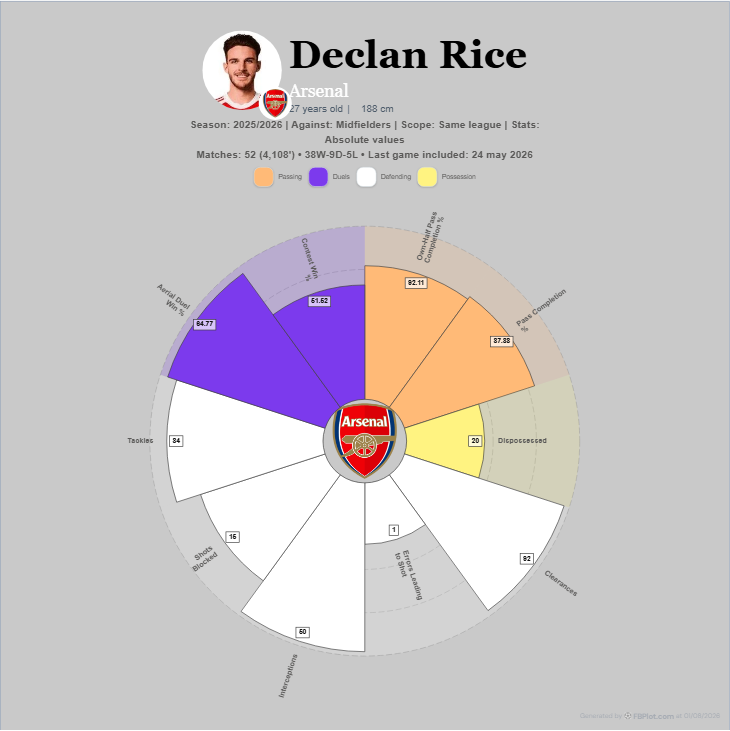
The right editorial move is to challenge the preset. If the assignment does not involve aerial work, why is that axis present? If line-breaking passing is central, is the available metric specific enough? A preset saves setup time; it does not remove judgement.
Team Contribution Changes the Lens
Per-90 rates ask how frequently a player records events while on the pitch. Team contribution, for supported metrics, asks what share of the team's activity came through the player.
The FBPlot bar below shows that second lens:
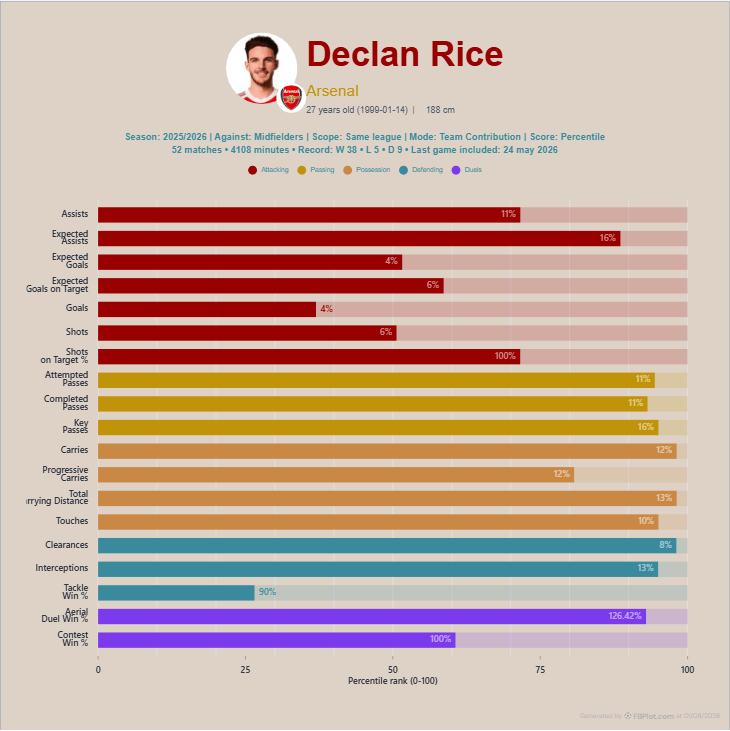
A midfielder can post a modest per-90 value and still account for a large share of the team's progression. Conversely, a high event rate may be less central in a team with several players sharing the work. Use the mode that matches the sentence.
What About Goals and Assists?
Attacking output can matter, especially for a double pivot player who arrives near the box. It should not become the default ranking for every defensive midfielder.
Goals + Assists describes the final outcome. Add it when the role expects final-third contribution. Keep it out when it would reward a different job and distract from the decision.
Build a Four-Part Review
For each candidate, write one paragraph under four headings:
- Protection: which spaces and transitions is the player responsible for?
- Security: how does the player receive, retain and recycle under pressure?
- Progression: how is possession advanced—carry, pass or combination?
- Exposure: how much football and what team environment produced the sample?
Choose two or three metrics per heading at most. Then attach clips that confirm or challenge the statistical pattern.
The Comparison Population Matters
Comparing defensive midfielders with all midfielders can mix holding players, number eights and attacking midfielders. A same-league scope controls competition context but not tactical assignment.
Use the narrowest defensible group, document it, and state where role ambiguity remains. A percentile against one population is not portable to another.
The football percentiles guide explains why changing the eligible group changes the result without changing the player's recorded actions.
The Quiet Performance Test
After building the chart, find one match in which the player recorded few defensive events. Watch the defensive transitions and first phase of possession. If the performance was still effective, identify what the chart could not see. If it was passive, identify which row failed to distinguish the two.
That exercise turns missing data into a method rather than an excuse.
In the FBPlot Profile editor, use a bar design when exact rows need to remain readable, or a radial pizza design for a compact role profile. In either view, the role sentence belongs above the chart in your notes.
Found this helpful? Share it with your network
More Articles
How to Read Attacking Midfielder Stats Without Counting Only Output
Read attacking-midfielder statistics through reception, progression, creation, box threat and defensive responsibility—not goals and assists alone.
How to Read Full-Back Stats: Defending, Progression and Width
Full-back statistics only make sense after identifying the role: overlapping, inverted, defensive, creative or transition-focused.