
A progressive carry means something different when it begins on the touchline, escapes pressure in midfield or creates an overlap from full-back.
Interpret progressive carries through role, starting zone, opportunity and team context instead of treating the same count as the same football action.
“He carries the ball forward” sounds like one behaviour. On the pitch, it can describe three very different jobs.
A winger may receive near the touchline and drive at the full-back. A midfielder may turn away from pressure and transport possession through the centre. A full-back may overlap into space created by the winger. Each action can register as a progressive carry under the active provider definition, yet the tactical problem being solved is different.
The current FBPlot catalog reflects that complexity by separating Progressive Carries, Progressive Carry Share %, Progressive Carrying Distance and Progressive Carries per 100 Carries. No single row contains the whole progression story.
Start With the Definition, Then Ask Where
“Progressive” is not a universal everyday word once it becomes a data field. Providers can use distance and field-location rules. Verify the current Progressive Carries metric page before comparing an external source or an older export.
After the definition, ask where the carries tend to begin and end. A central carry that breaks the first line and a wide carry that reaches the byline can both advance the ball while creating different advantages.
A season total does not reveal those zones. Use the metric to find the pattern, then confirm the mechanism through available location data or video.
The Winger: Isolation and Threat
For a winger, progressive carries often sit beside take-ons, touches, fouls drawn, crosses, key passes and entries into dangerous areas. The carry may be valuable because it eliminates a defender or forces the block to shift, even if the move does not end in a shot.
Volume matters, but opportunity matters too. A winger in a dominant side receives more possessions high and wide than one defending near the halfway line. Comparing the rate without possession context can reward the environment as much as the player.
The winger guide later in this cluster explains how to read winger statistics beyond goals.
The Midfielder: Escape and Connection
A midfielder's carry may begin under pressure. The important action is sometimes the escape rather than the final territory gained.
Pair carries with attempted and completed passes, touches, dispossessions and the team's structure. A player who carries less may progress mainly through passing. Another may carry because forward passing lanes are closed. The lower number is not automatically a weakness.
This is why the existing comparison of progressive carries and progressive passes treats them as complementary routes rather than rival scores.
The Full-Back: Space Created by the System
Full-backs can accumulate progressive carries through overlaps, underlaps or long advances into unoccupied space. Those actions may depend heavily on the winger moving inside and the team circulating possession toward the flank.
A full-back with fewer carries may be instructed to stay behind the ball, invert into midfield or release the pass earlier. Role video and team shape are necessary before turning the count into an attacking-grade judgement.
Compare like tactical jobs where possible. If the jobs differ, make the difference the subject of the analysis.
One Winger Profile, Several Progression Clues
The FBPlot winger pizza below places Progressive Carries beside carrying distance, touches, dispossessions, key passes and attacking outcomes.
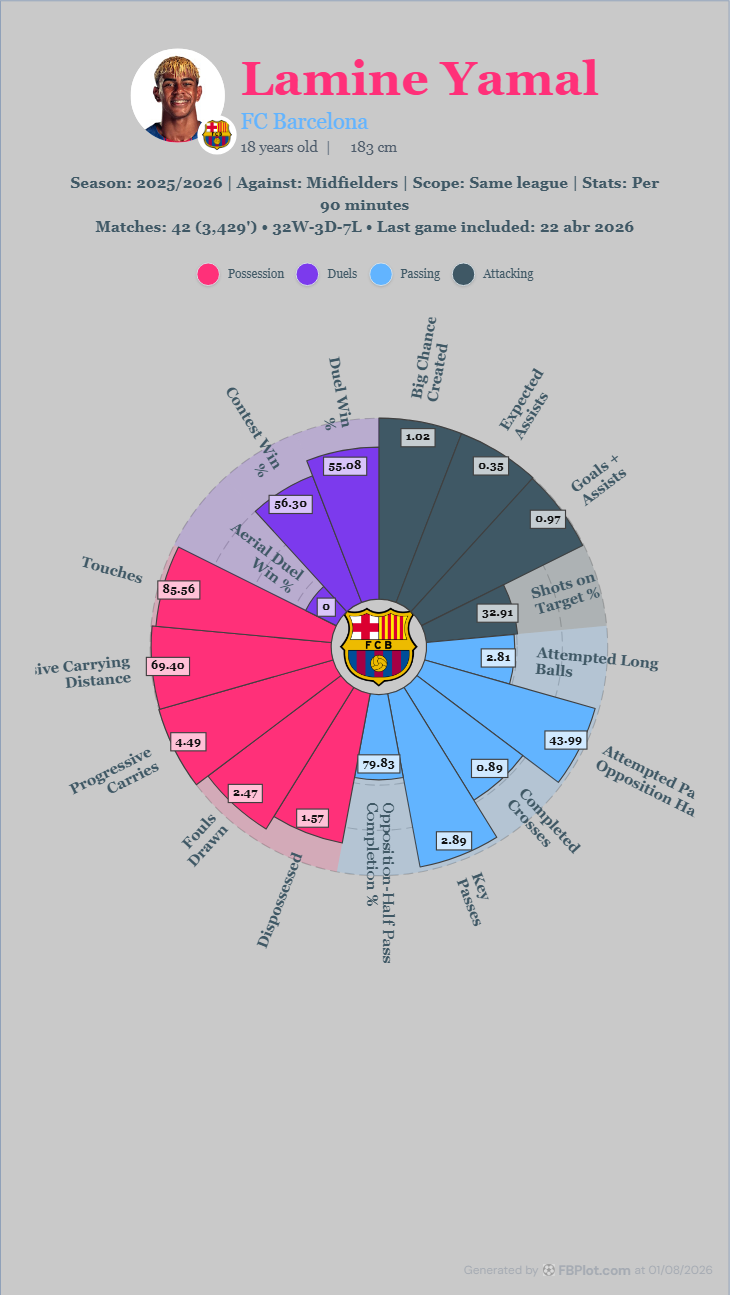
The chart is useful because it keeps related evidence visible. It is dangerous if the polygon is read as “more area equals a better winger”. Read the labels and values, not the silhouette.
Four Ways to Normalise the Same Behaviour
Progressive carries can be framed through different denominators:
- Total: how much progression accumulated across the period?
- Per 90: how frequently did it occur while the player was on the pitch?
- Share of carries: how much of the player's carrying activity was progressive?
- Per 100 carries: how frequently did progression occur given carrying opportunity?
Each asks a different question. The opportunity-based views can help distinguish a player who carries often from one whose carries are unusually direct. They still do not equalise starting zones or tactical instructions.
Do not combine these modes in the same ranking without labelling them. A percentage is not a per-90 rate, and a rate is not a season total.
Distance Adds Scale, Not Necessarily Value
Progressive carrying distance can separate many short advances from fewer long ones. Yet distance alone does not tell us whether the carry broke a defensive line, entered a dangerous area or ended with possession lost.
Use distance when the argument concerns how far the player transported the ball. Use carry counts when the argument concerns frequency. Use a chance-creation or possession-outcome metric when the argument concerns what followed.
That discipline keeps the metric set small and interpretable.
A Role-Aware Comparison Workflow
- Write the player's tactical starting role.
- Confirm the metric definition and period.
- Choose total, per 90 or an opportunity-based denominator.
- Add carrying distance and one outcome measure only if they answer distinct questions.
- Compare within a coherent role and competition population.
- Record minutes and possession context.
- Review several carries on video before explaining the mechanism.
The chart should help you choose clips, not replace them.
Open the FBPlot Player Bar Chart for a row-by-row comparison or the Player Pizza Chart for a compact role profile. Build separate winger, midfielder and full-back views before deciding whether one shared metric set is genuinely fair.
Found this helpful? Share it with your network
More Articles
Key Passes vs Expected Assists: Two Views of Chance Creation
Key passes count chances created; expected assists weights their estimated quality. Read them together to separate creative volume from chance value.
Shots on Target Percentage in Football: Accuracy Without the Shortcut
Shots on target percentage describes where attempts finish, but volume, location, shot type and sample size determine what the percentage can support.