
Key passes count chances created; expected assists weights their estimated quality. Read them together to separate creative volume from chance value.
Learn why key passes and expected assists can disagree, how teammates and role affect the numbers, and how to build a clearer football creation profile.
The pass before a shot and the value of the chance created are related, but they are not the same piece of evidence.
That distinction is the heart of key passes versus expected assists. In FBPlot's current catalog, Key Passes sits in the passing category while Expected Assists sits in attacking output. One records creative volume under the provider's event definition; the other assigns an expected goal value to the resulting chances under a model.
If the two metrics agree, the profile is easy to describe. The interesting work begins when they do not.
High Key Passes, Modest xA
Picture a player who repeatedly finds a teammate for shots from outside the box. The passes create attempts and can accumulate as key passes. If the resulting shots are low probability, expected assists may remain modest.
That is not evidence that the passes were useless. Repeatedly moving possession into a shot can be part of a valuable role. It does tell the analyst not to call every created attempt a major chance.
The next questions concern location and mechanism. Were the passes cut-backs, crosses, set-piece deliveries or short layoffs? Were teammates shooting early because the defence denied a better option? The event totals identify a pattern worth opening on video.
Modest Key Passes, Strong xA
Now reverse the profile. A player creates fewer shots, but several arrive in valuable areas. The key-pass count stays modest while expected assists rise.
This can describe a selective creator who reaches the byline or finds runners close to goal. It can also be driven by a very small number of exceptional chances. Minutes, match count and the distribution across games matter before calling the behavior repeatable.
Expected assists is still an estimate, not a guarantee that the teammate should score. Model inputs and provider definitions can differ. Keep the metric page or glossary definition attached to the analysis.
Assists Add a Third Layer
An assist records the realised outcome after the pass and finish. It depends partly on the teammate converting the shot. Key passes and expected assists retain information about chances that were missed; assists do not.
That makes the three metrics complementary:
- Key Passes: how often did the player create a recorded shot?
- Expected Assists: what estimated chance value followed those passes?
- Assists: how many of those sequences ended in a credited goal?
Do not use expected assists to declare that every unconverted chance was “deserved”. Use it to describe the opportunity created under the model.
One Chart, Three Layers
This FBPlot playmaker pizza contains Key Passes, Expected Assists, Assists and Big Chances Created in the same profile. The value of the design is not the coloured wedges; it is that related but non-identical creation measures remain visible together.
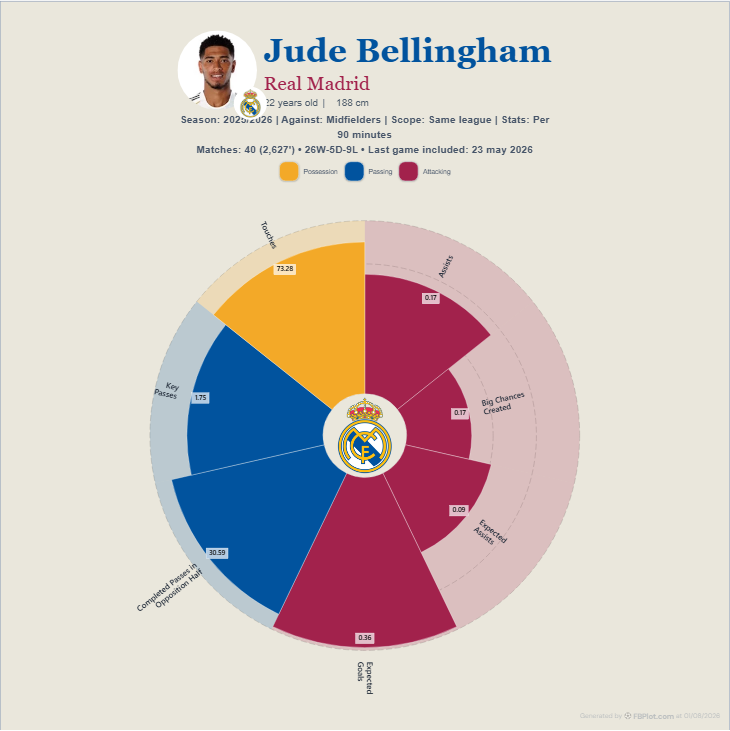
The chart does not turn those rows into a single creativity score. A writer should still refer to the individual labels and explain the role each one plays in the argument.
Per 90 Helps, but Role Still Matters
Key passes and expected assists can be read as totals or rates where the metric supports that mode. Per 90 makes players with different minutes easier to compare as event frequencies. It does not equalise possession share, set-piece duties or attacking role.
A corner taker may accumulate a different mix of chances from a midfielder creating in open play. A winger on a dominant team receives more possessions near the box than one spending long periods defending. Those are football differences, not statistical errors.
The comparison population should therefore be coherent enough for the question. “Midfielders in the same league” is more interpretable than an undisclosed mix of centre-backs, wingers and strikers.
Avoid the Creativity Score Trap
It is tempting to average several creation metrics into one number. That can be legitimate if the method is fixed and disclosed, but a casual average introduces hidden weights.
Key passes, xA and assists overlap. Putting all three into an unweighted composite can reward the same sequence several times: the pass creates a shot, the model assigns chance value, and the teammate scores. The sum looks comprehensive while quietly counting related evidence as independent.
If you need a composite axis, document the components, transformations and weights. The guide to composite football scatter axes provides a transparent method.
A Creation Profile That Reads Like Football
Start with one sentence about the role. Then choose a small set of measures:
- chance frequency: Key Passes;
- estimated chance value: Expected Assists;
- realised outcome: Assists;
- delivery mechanism: an available cross, through-ball or set-piece measure;
- possession context: touches, passes or team contribution where relevant.
Add minutes, period, competition and comparison group. If the profile has a large disagreement between volume and value, make that the question for match review.
This is also why Goals + Assists should not carry an attacking analysis alone. The final action is important, but the pathway helps explain whether two similar totals came from similar creative work.
What You Can Safely Say
A careful sentence distinguishes observation from interpretation:
Player A recorded more key passes per 90 in this sample, while Player B's expected-assist rate was higher. That suggests a volume-versus-chance-value contrast, subject to the provider definitions, role and small-sample check.
Open the FBPlot Player Pizza Chart, choose a playmaker-oriented metric set and keep Key Passes, Expected Assists and Assists as separate axes. If the conclusion still works after one is removed, it is less likely to depend on duplicated evidence.
Found this helpful? Share it with your network
More Articles
Progressive Carries by Role: Winger, Midfielder and Full-Back
A progressive carry means something different when it begins on the touchline, escapes pressure in midfield or creates an overlap from full-back.
Shots on Target Percentage in Football: Accuracy Without the Shortcut
Shots on target percentage describes where attempts finish, but volume, location, shot type and sample size determine what the percentage can support.