
Shots off target describe an attempt's outcome, not its danger or the quality of the finish. Read the number with volume, location, blocks and role.
A practical guide to interpreting shots off target in player analysis, separating the provider's event label from shot quality and finishing claims.
A forward cuts inside and bends the ball a hand's width beyond the far post. A minute later, a defender closes down another attempt before it travels five metres. Both attacks ended without a save, but they do not necessarily enter the same statistical bucket.
That distinction is why shots off target deserve more care than the label usually receives. The number tells us how attempts were recorded after the ball left the player's foot or head. It does not grade the decision, reconstruct the opening or tell us how close the player came to scoring.
What Counts as a Shot Off Target?
Definitions belong to the data provider, not to football folklore. In Opta's published event definitions, an off-target shot is a deliberate attempt that misses without another player diverting an on-target ball. Opta also treats an attempt that hits the frame and stays out as off target, while a blocked shot is a separate event.
That is one documented convention, not a promise that every dataset uses identical rules. Before combining sources or comparing a chart with a match report, check whether blocks, woodwork and last-line clearances are classified the same way.
FBPlot's current catalog likewise keeps Shots off Target, Shots on Target, Shots, Hit Woodwork and Shots Blocked as separate rows. The useful habit is to read those rows as a family.
The Denominator Changes the Story
Ten shots off target can describe at least two very different shooting profiles. If they came from 50 attempts, most efforts finished elsewhere. If they came from 14 attempts, inaccurate outcomes dominated the sample.
The raw count answers a workload question: how many recorded attempts missed the target? A share answers a composition question: what proportion of attempts did so? Neither answer is complete without the total number of shots.
This is also why an off-target count should not be compared casually across unequal minutes. A regular starter has more time to accumulate every shooting outcome. Use totals when accumulated output is the point; use a time-normalised view for frequency; then bring the absolute sample back before judging reliability.
A Miss Is Not a Chance-Quality Model
The post does not know whether the shot was a poor decision. An effort from a tight angle can miss the target even when the attacker had no better option. A central chance can drift wide after excellent movement created a high-value opening. Conversely, a harmless attempt straight at the goalkeeper can improve an on-target percentage.
Expected goals asks a different question about the quality of the chance before the result of the shot. It cannot make the finishing verdict on its own, but it prevents a simple outcome label from standing in for the entire opportunity. The guide to xG in football charts explains how to keep totals, rates and context apart.
Read the Whole Shooting Sequence
A useful shooting paragraph normally moves through four layers:
- Opportunity: minutes, role and how often the player reaches shooting situations.
- Selection: total shots and expected goals describe volume and the broad quality of attempts.
- Execution: on-target, off-target, blocked and woodwork outcomes describe where attempts finished.
- Result: goals describe what was converted.
The order matters. Starting at the third layer and jumping directly to “bad finisher” leaves the first two unexplored.
A Chart Should Keep the Misses in Company
The FBPlot Standard radar below places shooting outcomes beside expected and possession measures. It is not a verdict on the named player; it demonstrates the reading sequence.
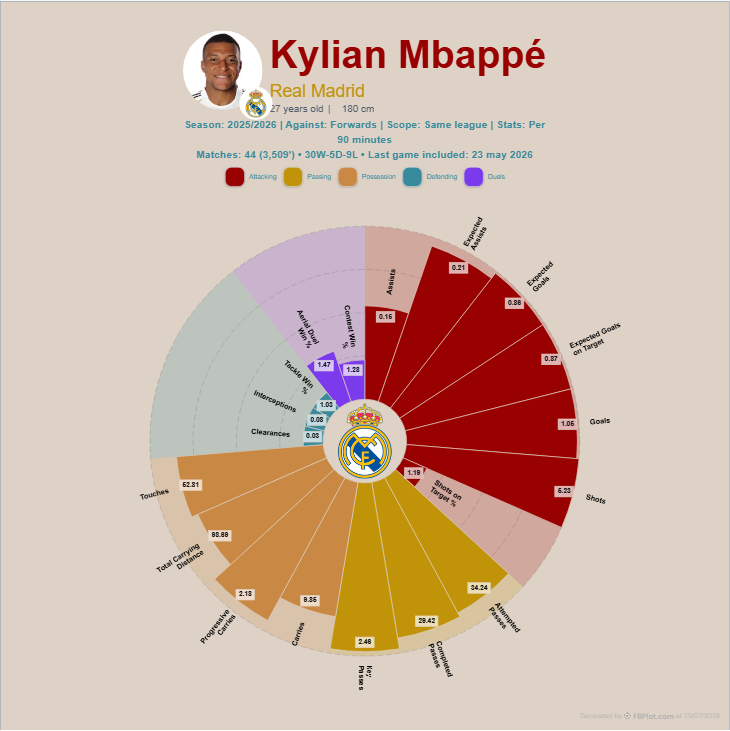
If one shooting axis looks unusual, move to a bar chart or table and inspect the underlying values. Radar geometry is good at prompting a question. It is a poor substitute for the denominator.
Role and Shot Menu Matter
A penalty-box striker, a wide forward cutting inside and a midfielder shooting through traffic receive different menus of attempts. Their off-target rates can reflect location, pressure, body orientation and tactical instruction as much as a stable finishing trait.
This does not mean every miss can be excused by role. It means comparisons should begin with similar jobs and then state the differences that remain. The striker-stat framework makes that role contract explicit.
Match state matters too. A player chasing an equaliser may attempt lower-probability shots late in the game. A team protecting a lead may shoot less often but from transitions. Aggregate counts flatten those decisions.
A Sentence That the Evidence Can Carry
“He is wasteful because he has 12 shots off target” is too broad. A defensible version is closer to this:
Across the selected period, a large share of the player's recorded attempts finished off target. The sample contains enough attempts to investigate, but shot location, blocks, role and chance quality are still needed before making a finishing claim.
That wording is not timid. It says exactly what the data establishes and names the next test.
Open the Shots off Target metric page to confirm the current FBPlot label, then build a profile in the Player Bar Chart with Shots, Shots on Target, Shots off Target, Shots Blocked, Goals and Expected Goals together. The pattern will be far more useful than the miss count alone.
Found this helpful? Share it with your network
More Articles
Pass Completion Percentage in Football: Accuracy Without Ambition
Pass completion percentage measures successful attempts in a selected pass set. It does not reveal difficulty, direction, pressure or creative value.
Team Contribution in Football Metrics: What a Player's Share Reveals
Team contribution shows a player's share of supported team activity. It adds structural context but does not prove efficiency, quality or causation.